


 Preventive Health

 Contact Us
 Career

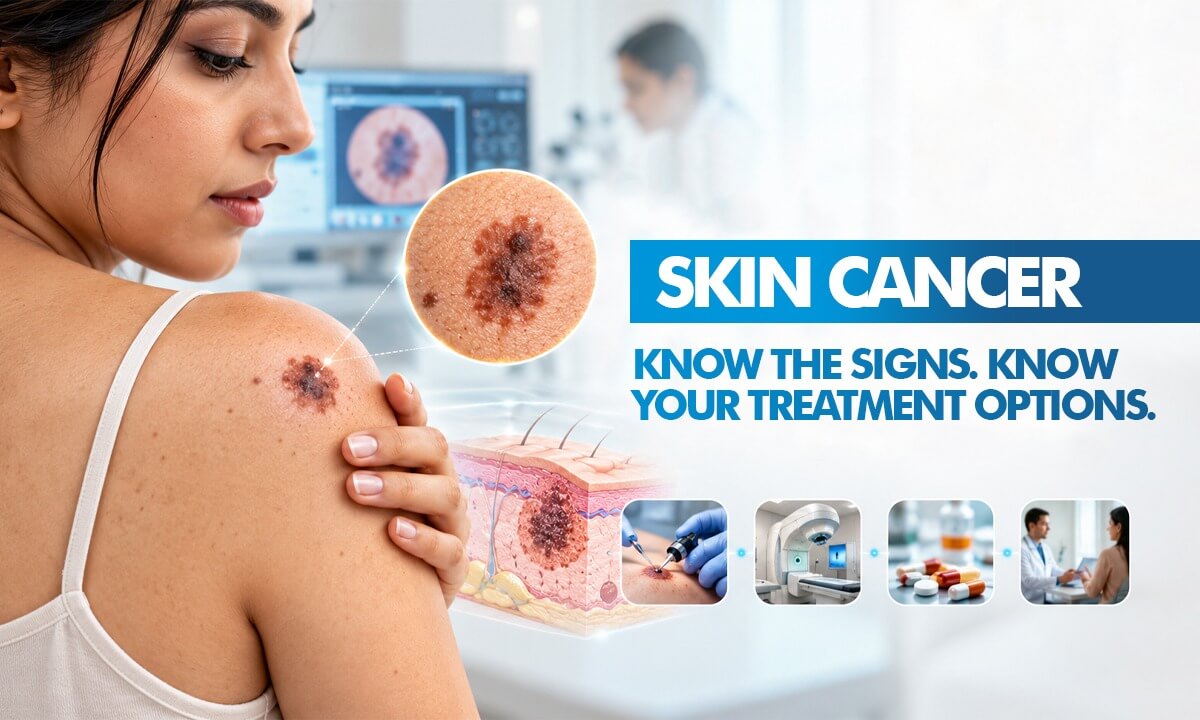
Skin Cancer Treatment in India: Symptoms, Diagnosis and Modern Treatment Options
The cancer of the skin is formed due to abnormal growth of the skin cells. Although there are some forms of skin cancer that are less aggressive and slow-growing and can easily be cured if detected early, there are some types that are highly aggressive and can even spread to other body parts. Early detection of the changes in skin is essential.
When it comes to those who are looking for the best hospitals to treat skin cancer in India, it is essential to know what the symptoms are, how it is diagnosed, and what treatments are available for the condition. The treatment of the disease varies from one patient to another depending on several factors.
What Is Skin Cancer?
If there is an alteration in the skin cells causing the multiplication of skin cells without control, then this disease is referred to as skin cancer. There are three types of skin cancer, including basal cell carcinoma, squamous cell carcinoma, and melanoma.
The non-melanoma skin cancer is made up of two types of cancer, namely: Basal Cell Carcinoma and Squamous Cell Carcinoma. This form of skin cancer is mainly caused by exposure to UV light and easily curable if detected early.
Melanomas are formed from the melanocytes responsible for skin coloration. This is a very rare type of skin cancer.
What Causes Skin Cancer?
Exposure to UV rays of the sunlight over an extended period of time is one of the major risk factors for the development of skin cancers. Some of these other risk factors may be as follows:
- Repeated sun exposure or getting sunburned
- Frequent use of tanning beds
- Having fair skin that gets sunburned easily
- A large number of moles
- A history of skin cancer in self/family
- Some genetic disorders
- Immune deficiency
- Earlier exposure to radiations under certain circumstances
The presence of any of these risk factors doesn’t necessarily mean that the person is going to get skin cancer. People who do not have any of these risk factors may also get the disease.
What Are the Symptoms of Skin Cancer?
Skin cancer can come in various shapes and forms, and hence it would be prudent to keep an eye on new skin lesions or those that keep changing.
These warning signs include:
- The emergence of new growth or an unusual skin patch
- A sore that does not heal
- A wound that keeps bleeding or crusting
- A mole with changes in its size, shape or colour
- An irregular border in the skin lesion
- A mark on the skin that is quite different from others around it
- Persistent itching or tenderness in a skin lesion
- Rapid growth or changes in a skin growth
One way to assess suspicious moles is using the ABCDE rule which involves:
A – Asymmetry: One side of the mole is different from the other.
B – Border: The borders of the mole are irregular or uneven.
C – Color: There are many or unusual colours in the lesion.
D – Diameter: The mole is more than about 6 mm, but melanoma is usually smaller.
E – Evolution: The mole or skin lesion evolves.
This is not a diagnosis of melanoma, but rather a set of signs that could require a specialist’s opinion.
Why Should Suspicious Skin Changes Be Checked?
Not every unusual mole, patch or skin growth is cancerous. Many harmless skin conditions can look similar to skin cancer.
However, delaying evaluation of a suspicious or changing lesion can allow a cancer to progress. Early assessment gives doctors an opportunity to identify the cause and, if cancer is present, determine the appropriate treatment at an earlier stage.
People should not attempt to diagnose a suspicious lesion solely from photographs or online information.
How Is Skin Cancer Diagnosed?
Diagnosis of the condition is initially performed through a skin examination. A dermatologist or any other qualified medical specialist can perform a dermoscopic examination of the suspicious area. This method allows a magnified visualisation of structures that cannot be seen with the naked eye.
In case of cancer, a skin biopsy is usually done in order to confirm the presence of such a disease. Skin biopsy involves excision of either part or the entire suspicious area and sending the sample for analysis.
The results obtained from the analysis help to determine the type of skin cancer.
Is a Biopsy Always Necessary?
A biopsy is generally needed to confirm whether a suspicious lesion is cancerous. The type of biopsy depends on the size, location and appearance of the lesion.
In some cases, the entire lesion may be removed during the initial procedure. In others, only a portion may be sampled before a definitive treatment plan is made.
The treating specialist can explain which approach is appropriate for the individual lesion.
What Are the Modern Skin Cancer Treatment Options?
Treatment options for skin cancer in India vary depending on the nature of the skin cancer. The methods used for treating skin cancer include surgery, radiation therapy, topical medicine, immunotherapy, and targeted therapy among others.
Surgery
Surgery is a common method for treating many types of skin cancer. In cases where the disease is limited to a small area, the objective of surgery is the elimination of cancer from the body. The surgery will depend on the size and location of the tumour as well as the type of cancer.
In some instances, Mohs micrographic surgery may be recommended. This is the process of removing a tumor in a series and examining the tissue throughout the process in order to eliminate the possibility that all cancer cells have been removed.
Radiation Therapy
Radiation therapy makes use of high energy rays for the destruction of cancer cells. Radiation may be used in cases where surgery cannot be used due to complications, in case of incomplete surgical removal or where there is a risk of cancer recurrence in a specific location.
Radiation therapy may be considered in certain cases of advanced skin cancers.
Topical Treatments
Superficial skin cancers and precancerous skin lesions may be treated with medicines applied on the surface of the skin.
Not every type and stage of skin cancer can be treated with topical treatment. A specialist assesses whether it is appropriate to use the method in relation to the characteristics of the lesion.
Immunotherapy
Immunotherapy is the process of enabling the body's natural defense mechanism to recognise and kill cancer cells. This form of treatment has proved very useful in certain cases of advanced skin cancers, especially in cases of melanoma.
Some immunotherapy medicines may be prescribed in selected cases of advanced non-melanoma skin cancers.
Whether immunotherapy is an appropriate choice will depend on the type and stage of cancer, among other factors.
Targeted Therapy
Targeted therapy drugs target specific molecules which facilitate the growth of cancer cells.
The molecular profile of a certain melanoma may help in determining whether it is a good candidate for targeted therapy treatment.
What Is the Treatment for Melanoma?
The management of melanoma is very much dependent upon the stage of the condition.
For early melanoma, surgical excision might be enough. But if the condition has spread to nearby lymph nodes or distant organs, then some further treatments are needed.
It could be either surgical, immunological, targeted, radiotherapy, or any other form of systemic therapy.
Being aggressive in nature, diagnosis, and staging of the melanoma becomes critical.
How Do You Choose the Best Hospital for Skin Cancer Treatment in India?
When searching for the best hospital for skin cancer treatment in India, a person should go beyond any kind of ranking or online reviews.
Among other things, the following should be taken into account:
- Treatment experience in different kinds of skin cancers
- Availability of dermatologists and oncologists
- Biopsy and pathology availability
- Correct surgical skills
- Facilities of radiation oncology when necessary
- Immunotherapy and targeted treatments availability for patients qualified for these treatments
- Multidisciplinary cancer treatment
- Support services
- Information about treatment options and possible results
The ideal hospital will be that one which is able to provide the necessary treatment for particular cancer, not just the "best" one.
What Does a Cancer Specialist Hospital in India Offer?
Cancer specialist hospitals in India may combine all the fields of medicine necessary to diagnose and treat the disease.
According to the condition, the treatment team can include dermatologists, surgical oncologists, medical oncologists, radiation oncologists, pathologists, radiologists, and other specialists.
This kind of teamwork is especially useful if the treatment is multi-modal or the disease has spread beyond the primary skin lesion.
Can Skin Cancer Be Prevented?
Although skin cancers cannot always be prevented, there are ways of decreasing risk of exposure.
Methods of sun safety could include:
- Application of broad spectrum sunscreen where required
- Use of clothing when in direct sunlight
- Utilisation of hats or physical sunscreens
- Staying in the shade at times of high sunlight
- Avoiding use of sun beds
- Ensuring special care in case of long time exposure to sun
- Regular checking of skin for any abnormal moles
It is necessary to have sun protection as part of routine skin care and not just on vacation days.
When Should You See a Doctor?
You should consider medical evaluation if you notice:
- A new skin growth
- A mole that is changing in appearance
- A sore that does not heal
- Repeated bleeding or crusting
- A lesion that is rapidly changing
- A persistent skin growth that looks different from others
Early evaluation does not necessarily mean that the lesion is cancerous. It simply allows a qualified professional to determine what is causing the change.
Why Choose Action Cancer Hospital for Cancer Care?
The Action Cancer Hospital offers special services related to cancer treatment for those patients who have been diagnosed with various forms of cancers. They can consult various specialists to get the best possible idea about the disease and its treatment.
For those patients who are searching for a cancer specialist hospital in India, the main emphasis should be on finding an appropriate diagnostic centre and specialists who are experienced in treating the specific cancer.
Frequently Asked Questions
1. What is skin cancer treatment in India?
The skin cancer treatment in India includes a number of possible approaches including surgery, radiotherapy, local drug administration, immune or targeted therapy. This type of treatment depends upon skin cancer type, localisation and stage of development.
2. What is the best hospital for skin cancer treatment in India?
The best hospital for skin cancer treatment in India depends on individual features of each case. Patients need to take into account the qualification of a hospital in oncology, diagnostic and pathological possibilities, the possibility of surgical treatment, radiotherapy and systemic therapies.
3. What are the early signs of skin cancer?
The first warning signs of skin cancer include changes in the appearance of moles, skin injuries that do not get better, peculiarities in skin growths, repeated injuries or crusting or the lesions that differ from other spots. All such symptoms should be discussed with a professional.
4. Is every mole a sign of skin cancer?
Not all moles are cancerous. Nevertheless, patients need to consult their doctor regarding changes in moles: change in size, shape or colour, development of an irregular edge and others.
5. Can skin cancer be cured?
A great number of skin cancer cases may be treated if patients diagnose their disease in time. The chances of successful treatment depend upon skin cancer type, stage of development, localisation and other features.
6. Is surgery always needed for skin cancer?
Surgery is one of the most common forms of treatment of skin cancer. Nevertheless, sometimes radiation therapy, local drug administration, immunotherapy or targeted therapy may be applied.
Taking Skin Cancer Seriously
Skin cancer comes in different shapes and sizes, and all changes on the skin are not always cancerous. Yet being able to spot anything abnormal about the skin and seeking evaluation on time will make it easier to detect the disease at an early stage when it is easier to treat.
When people ask where the best hospital for skin cancer treatment in India is, the first step should be seeking a hospital that has adequate infrastructure in terms of experts, diagnostic tools, and treatments for that particular disease.
